Wednesday, April 14, 2010

Joanna (Asha) Sturmilowska - Poland


I volunteered with Dakshinayan in February 2010 and I have to say that this was the most amazing experience of my life! Not only because I was in one of the most remote parts of India where not many foreigners had manage get to, but most of all because I hopefully had a chance to help with bringing education to children who otherwise wouldn’t have a chance for it. My only regret is that I could stay there just for one month and trust me, this is not enough, and my plan is to go back and stay for longer.
Like some of the volunteers before me I had no previous experience with teaching except what I took away from my own school years. But this is really not as difficult as you may imagine. I had been teaching class 3 and 4 so the kids who had previous experience with volunteers and could communicate in English quite well. Two things that I tried to do was to show the kids that I really care and make the teaching as much fun as it was possible. The greatest reward was when I realized that they listen and remember what I was trying to teaching them! So if someone is thinking about coming to Dakshinayan but is afraid that one month will not make any difference than I can tell you otherwise! It makes a great difference! Those kids will listen to your every word because they really want to learn. It was really amusing when in the afternoon when kids were coming to play they sometimes rather play hangman than cricket. :)
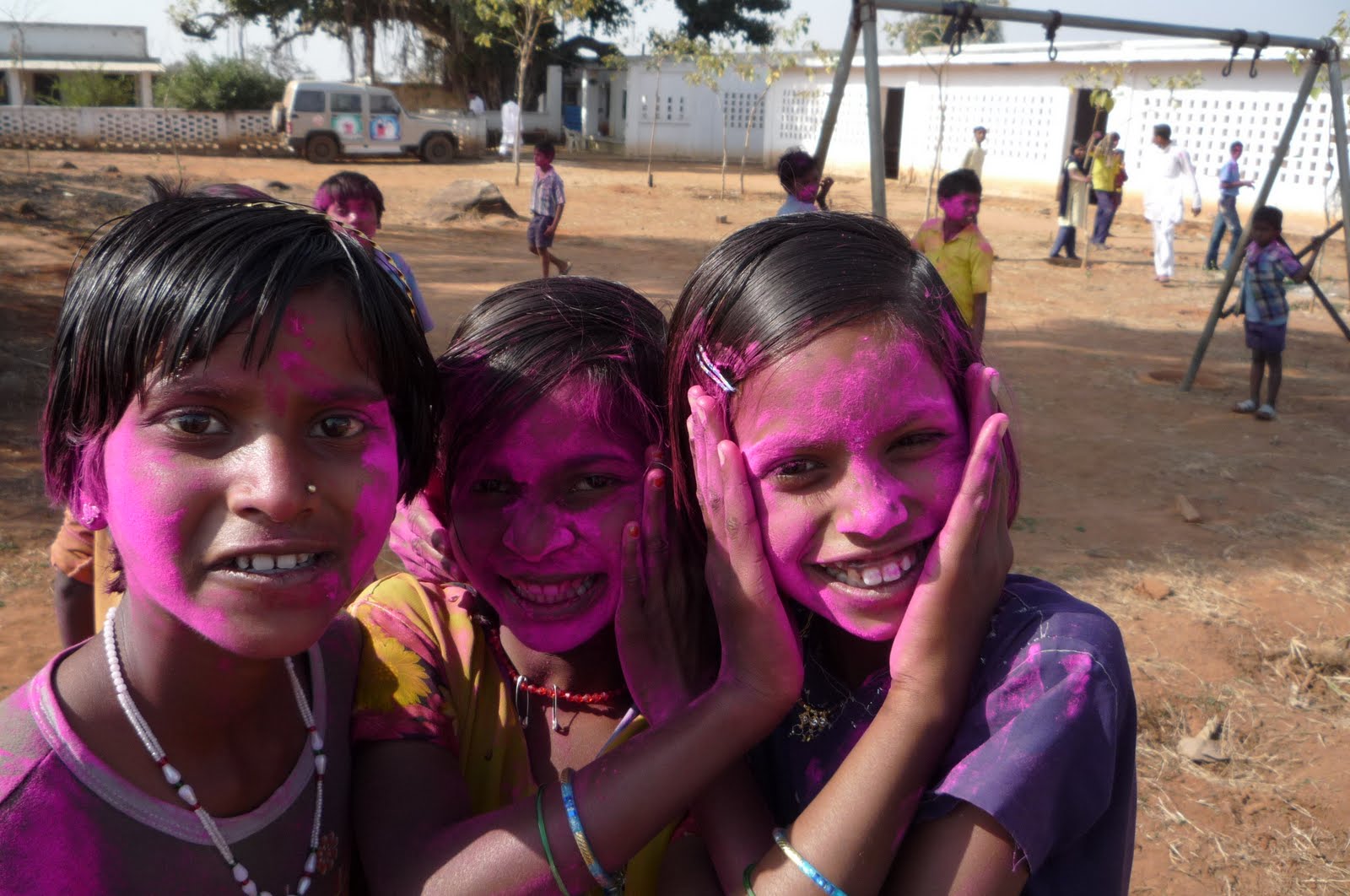
The life at the project is simple but it actually felt more comfortable than I was expecting. Everybody wakes up very early at the project and sometimes I was up at 5.30 in the morning but there is nothing more beautiful than the sunrise over the hills and amazing landscape behind the project. You go to sleep very early too so waking up is not a problem after a while. I was given my “own” solar panel so I was able to read comfortably in my room after dark. I found as well that my favour pass time was helping Shonku, one of the workers at the project, with cooking. And I am a person who does not really do any cooking ever! However a food preparation at the project is something so completely different to what we are doing in our kitchens that even I got interestedJ. Going to a village market was something no one should miss either and learning yoga with kids was one of the funniest experiences I had at the project! But one of the best days was without doubt Holi festival. I can’t even describe the joy and energy with which kids were participating in the celebrations, throwing at themselves (and me) colourful powder! And even though I looked later like a pink monster I don’t think I would exchange that day for anything!
Where India completely blows your mind and can make you go mad, coming to the project is like finding yourself on an island where life goes on according to completely different clock than rest of the world. I came across this organisation by accident and it was the volunteer’s blog which persuaded me to go to the project so I hope that whoever reads this will get some inside to the life at the project and it will help you to make up your mind like it happened to me, because it is really worth it. If you have any questions about how it is to volunteer for Dakshinayan you can email me on asia_toja@hotmail.co.uk .
Good luck ;)

Thursday, March 25, 2010

Sim McCarter-Ribakoff - December 2008


I just want to start off by saying that working on the Dakshinayan project was one of the most incredible and fulfilling experiences of my life. Because Dakshinayan volunteers are a rather diverse group of people, I figured I may start off by telling you a little about myself so you know where I coming from. I volunteered in December of 2008 at 20 years of age. In my search for a volunteer project to work on, I was in the unfortunate predicament of wanting to participate in a project where I could help out in a meaningful way, yet as a young college student I did not have any professional skills to offer. I also wanted to work on a small project that gave me much more than a superficial experience of the area's lifestyle and culture, and finally I didn't want to spend an extraordinary amount of money to volunteer MY services.

By happenstance I found Dakshinayan, and it turned out to be just what I needed. Because all of the travel to and from the project are the volunteers responsibility (although Siddharth will give you very detailed instructions on where to go), the project fee is small and just basically covers room and board for a month. And the small scale of the project means that not only do you get a intimate feel for the community there, but also you become an integral part of the project. The volunteers are elementary school teachers, and help to provide the only formal education many of these kids will ever receive. Of course support is provided, but you can rest assure that the work of the volunteers not only important, but vital to the project.

Volunteering in Roldih was a bit challenging. Just the trek to the project required a all-night bus ride then an hour taxi ride on the uneven dirt roads of Jharkhand. Then of course there is no electricity or running water on site.But none of that really bothered me much, it was actually really exciting and made for some great stories later. It was kind of a surprise to me that the most challenging part of project life for me was the more relaxed pace of doing things there. It became very apparent to me, that I had been cultured to believe that if I wasn't doing something "productive", I was wasting time. Of course, that's not to say that back in the USA I was always working on something, but I would say that I feel that always something productive to working on. That was a major culture shock for me on the project. I first arrived on the project at about 7am after the all night venture from Kolkata, and I was itching to explore, meet new people, and most of all to meet the children. That is when I encountered my first frustration when Siddharth kindly told me to go rest. The first few days were probably the hardest as I grew increasingly annoyed with the relaxed pace of life. I felt that I had traveled all the way around the world to work on the project, not to rest. I had arrived during the annual final exams so during the morning I was simply proctoring exams, then the afternoons were without any work save a few daily chores. I became restless. Fortunately, I decided to stick it out. Soon enough I was teaching and I learned to love the relaxed atmosphere. Obviously it was a major adjustment from what I was used to, but after thinking about it, that is exactly what I had come to do. I wanted to experience a different culture and lifestyle. I hadn't really realized the full implications of what it meant when I said "I wanted to be immersed in another culture", but after about one week it hit me and I came around. I learned to love the frequent "Chai Breaks", the afternoon strolls with Suman the cook, the long philosophical discussions with Siddharth, stretching out in the sun with a good book, and even the afternoon naps. People in Jharkhand have the nasty stereotype of "being lazy", and sometimes it is a challenge to get things done on the project, if for example the local painter skips out on a day's work without any notification. But on the whole, it's just a different lifestyle. People value the time they spend with one another and value their relaxation time. The different priorities really struck a chord with me and made me questions whether I had my priorities straight. Even though I have returned to the fast-paced world in the USA, I have not forgotten the lesson I learned in Roldih. And besides, in the year that I've been back in the States, I have still yet to find a cup of chai that could even come close to comparing with what I had in Roldih.

Of course I cannot talk about project life without mentioning the children. The students of Dakshinayan are possibly the most motivated and incredible group of kids I've ever meet. Like I said previously, I arrived during final exams and the school would officially be on holiday almost my entire stay. Yet Siddharth told me that I could stay hold class everyday and teach as I pleased in order to prepare them for the official start to the year in January. To my surprise, despite the school being on holiday, I still got almost 100% attendance everyday that month. These kids really want to go to school and they love to learn. I taught math, science, English, and social studies. I taught them songs, read them books, and encourage art, and they devoured everything I could give them. The language barrier was a big challenge at first, as I did not speak Hindi or any of the local languages. However, as I soon learned children are the easiest people to communicate with when there is a language barrier. They pick things up very quickly and I could just use super-animated body language (which I reveled in doing) to convey my message. Even if teaching is not your strong suit, simply playing football and carrom, or sharing your culture (like through pictures) is a wonderful way to connect with the children. They are so open and friendly to all of the volunteers as they really look forward to meeting the foreigners. In fact, come to think of it, everyone from the kids, to coworkers on the project, to villagers and people in the marketplace are so friendly and warm to foreigners. It's incredible.

Well, I've probably rambled on long enough and kudos to anyone who has read this far. Let me just say the volunteering with Dakshinayan was an phenomenal experience for me, and if go in with the right attitude and mindset, I'm sure it could be a powerful experience for you as well. Just a bit of advice, do your research. Both on traveling to India in general and on the happenings of the project as I know just in the past year the project has gone through some big changes. So read the blog, talk to Siddharth, and if you'd like email past volunteers. Please if you have any questions about the project send me an email at mccarterribakoff_sim@berkeley.edu and I'll be happy to respond. Best of luck!

Sunday, August 23, 2009

Richard Galletly - UK

I travelled to Dakshinayan in June 2009 during the height of a blisteringly hot summer and before a monsoon that never really came. To be completely honest, cooler weather would have been nice but, that’s the only thing I would change. Travelling from the train station across beautiful landscapes and potholed roads a small voice in my head did question what could happen to me in the middle of rural India. Particularly as almost every Indian I’d spoke to before arriving seemed shocked and genuinely worried for me that I was going to Jharkhand. I never once felt in any danger though, and didn’t meet anyone who wasn’t anything but friendly and helpful.

From the start I got involved with teaching the kids and playing with them in the afternoon. I wondered how I’d manage to teach at first, but with a textbook and the enthusiasm of the kids, despite no prior teaching experience I found a way that worked for me and, more importantly I think the kids found it OK too. I was aware when organising my trip to India that teaching was the reason I was going. Obviously I’d been to school in England and had heard how important education was millions of times. Actually teaching here brought that home in such a strong way though.

Visiting the children’s homes was a good way to get to know them better, as well as gaining an appreciation of how they lived, a huge eye opener for someone from the UK. I never felt awkward visiting the homes. The families were very genuine, interested in where I was from, found my attempts at Hindi very humorous (in the best possible way) and were always trying to give me food or offering to let me stay in their homes for the night.

I visited a market twice a week to help buy some of the food for the project - a real social event for the local area, which most people dress up for. There were always lots of people there who wanted to talk to me about where I was from and why I was in Jharkhand. Eventually I took photos to show them and spent time explaining what was in the various photos.

I couldn’t recommend the project enough. You get to know a community, not as someone observing from a distance but, as someone living and interacting with them. Teaching the kids is its own reward and the whole experience will teach you as much about yourself as it will about the communities there. There are periods of time with little to do but, if you’re aware of this before you go and don’t mind using your initiative to get involved it’s not something that detracts from the overall experience.

I initially found Dakshinayan due to an interest in development economics, and it certainly helped me in this area. If you’re in a similar situation or just wish to ask about Dakshinayan feel free to contact me through Facebook (I’m in the Dakshinayan group).

Monday, June 22, 2009

Renee Berkhout - UK

I would highly recommend getting involved with Dakshinayan to anyone that wants to teach and get a taste of simple rural living in India. I love reminiscing about my time at the project as it really touched me and I had an experience I will never ever forget.

I was only there for a month, which before going seemed like an incredibly daunting prospect, however as time passed I quickly realised that I could easily have stayed longer. I would love to return to the project again one day but will continue to support it from a distance and I enjoy being updated as to what is going on through the blog that Siddarth keeps (http://www.dakshinayan.blogspot.com/).

For me, the best part of the experience was easily the teaching – the children were a true pleasure to work with. They are incredibly well behaved, show you great respect and it is great to see the results of your teaching. I had doubts as to whether I would really make much difference in the short space that I was there, however it becomes more apparent when you observe the difference between the children who are in Nursery (who speak no English) with the children in Class 4 (who can understand everything that you are saying, read challenging texts and can communicated clearly). It is truly amazing! I now miss the daily chorus of ‘Good Morning Miss’ said with a smile and seeing the kids line up for assembly to sing the national anthem in their cute little yellow and navy uniforms.

I have never done any teaching before however you quickly pick it up. You are given textbooks to work from and then you have the autonomy to teach in a way that suits you provided that you cover the necessary areas. I found this very freeing as it allowed me to use my creative side and teaching made me feel so alive.

The way the day is structured is great as you teach for three hours in the morning and then have the afternoon off to enjoy the beautiful scenery, chill out and to help out with chores. I call them chores, but it was fun to help out as whilst I was there as this involved watering plants with buckets of water from the well and painting benches for the classrooms.

You live a very simple lifestyle as the food is basic, there is no electricity and you feel like you are in the middle of nowhere however I found this refreshing and it is part of the adventure. Where else could I watch a herd of goats and buffalo being ushered across the land? To the local villagers this is a part of everyday life yet to me it was an extraordinary site. I found the landscape fascinating, unlike anything I’d ever seen before and I loved learning about how the villagers live.

Dakshinayan also has its little luxuries - there is a Western style toilet, a volunteer phone, the food may be basic but you can eat as much as you like (you do get very hungry after teaching) and Siddarth, the leader and co-ordinator of the project is very kind and does his best to make it comfortable for you. I have immense respect and admiration for the way he runs the project and the amount of time and effort that he has dedicated to the school, he is doing a great job and there is a great to deal to be learnt from him.

Just to reassure anyone that has any qualms, my main fears were:
-Not being able to drink the water (there are huge water containers that have a filter so you can drink this)
-Travelling to the project (sounds scary and yes it is a bit of a bumpy ride, however it’s fine)
-Going to Jharkhand (it has a reputation as one of India’s poorest and most dangerous states and even some Indians are wary of going there however at no point did I feel threatened or scared. As so few outsiders visit Jharkand it makes it an even more interesting and valuable place to visit.)
-Not knowing what to teach (you are given a text book and then left to it so you can explain things in whatever way works for you.)
-Going hungry (you may get sick of rice, but in general I loved the food which was usually rice, veg and daal.)
- Climate (I went during the months of January when the temperature in the day was lovely and it even got cold at night sometimes, by Indian standards that is, but it was not a problem. It is probably a good idea to check out what the weather will be like when you plan to be there)

I could go on with more praise for the project but you get the idea..... I am intrigued to see how the project has changed since I have left seeing that they now have a few laptops which will radically change the way that they learn, exciting times are ahead for the school.

Good luck to anyone that is going, you will have a great time and feel free to email me with any questions on reneeberkhout@gmail.com if you want to know more – I love Dakshinayan!

Friday, May 22, 2009

Danielle Grindlay -- Australia

Dakshinayan…I can’t make you realise how amazing it is without dragging your anxious behind along with me…and no-one wants to read about ‘how it changed my life’…SO I guess what I would have liked before I left is someone to annul my doubts…which I will try and do for you:

Does it exist? We live in an evil world. I was coming from safe little Australia and all anyone had to say about India was “Don’t trust anyone. They’re all out to get you. JHARKHAND…are you crazy?” Truly comforting. Especially since I found Dak through a random link on a random website.
And yet all of a sudden I had $600US dollars (I went with a friend) strapped to my stomach and had placed all my trust in this mysterious ‘Siddharth’ character I’d only spoken to via email.

And I’ll be grateful for throwing caution to the wind for the rest of my life…but none of that soppiness…
He really does organise every single aspect of your travel – which was the most daunting thing for me…jumping on a 12 hour bus after a strange man approaches you with a mobile phone and Siddharth’s voice tells you to do what he says…it felt like some kind of movie and I couldn’t help but inwardly farewell my organs. Clearly I was a tad dramatic. But coming from my safe little bubble, Kolkata literally blew my mind.

Is it worthwhile? Please don’t have any doubts about the value of your time on the project (as I did most days). Siddharth is one amazing man. But that’s the problem. He is just one. Not enough for the 85 children that attend his school.

And don’t think that your role is a small one either – you are a teacher. No ‘cutesy’ bullshit, taking photos of children and gushing to your friends back home about how adorable and sad they were. Siddharth is heavily dependant on volunteers to supply these kids with the only education they may ever receive.


Teaching. It seems simple enough…but when there are 20 children who speak minimal English staring at you blankly, it is slightly unnerving. Yes they are left solely in your care for the school day. I couldn’t believe it. I’m not qualified to teach! I’m 23 and still a student myself…then I realised what I had to offer was me. My language. My culture. And somehow the lessons just unfolded. The difference between
Australian kids and these little gems was they were DESPERATE to learn.

In Australia school is compulsory and most of a child's time is spent figuring out how to avoid it. It is a fight for some of the kids in Roldih (the village) to even attend school...and they thrive on every minute they're there. There is nothing more rewarding than teaching someone who wants to learn. And it's amazing how much they do learn in such little time. There's no mucking around and certainly no lack of respect - this is what makes it so special because it is real. You have a major impact on their lives.OK so I'm rambling...Every day life: peaceful, relaxing, carefree...FREE of all the bullshit...do you like reading? writing? pondering the world? yoga? meditation? I wrote every day. And I treasure the thoughts that came out on the page. It is absolutely beautiful there. The sunrises/sunsets and BRIGHT moon make you appreciate the natural wonders we have been given - don't get me wrong I'm not the sentimental romantic type - but that place will bring out the cliché phrases in anyone...We weren't pressured to do much more than teach...but there are always things to do...and we loved being involved with the day to day activity. So after school we painted school benches, watered the plants with buckets, helped Suman cook the dinner etc. There's always something going on and I actually wish I didn’t hold back so much waiting for an invitation to join in. Siddharth will go out of his way to help you...if you want it. He is a natural teacher. I don't know how old you are, but his wisdom left me in awe.

The kind of wise man that doesn't dictate or alienate those he talks to - he's a man of the world and very open and easy going with a GREAT sense of sarcastic humour. Because I was interested in Hindi, he taught me. I was interested in meditation, so he taught me. I asked him a simple question about the water pumps and he sat me down and gave me a full lesson in a classroom. He told me Hindu mythology...and I actually found myself intrigued! Strange for Miss Cynical me...Someone that has given up their life for a cause and spent decades segregated from 'normalcy' has an extremely unique and valuable idea of the world.

The food is simple, but there is plenty of it and I gained a great appreciation of spice and home grown flavours. Definitely join GORGEOUS little Suman in preparing the meal. He and Banshi (the other worker/teacher on the project) are 2 of the warmest hearted, most positive characters I'll ever meet. Their appreciation of life left me envious and ridiculed my initial impression that they had nothing compared to me.


We also went on a trek to one of the project's old schools, now run by the villagers there in Cheo...through the incredible Indian rural land...once again, you'll just have to see it to appreciate it.


Hrm...other possible concerns...contact with the outside world? You are given your OWN mobile phone...credit is cheap as could be and even if you don't want to call people, they have a number to contact you (handy for an irrational mother).

I can't really think of anything I can say that won't make you want to vomit...but it has changed my life.

I believe all humans have the innate desire to aid those less fortunate and share their love with the world...and because of this, there are plenty of phoney 'volunteer' programs...when you find something you truly believe in and see the impact you have first hand through the keenest, brightest, delightful little children...it's hard to ever see the world in the same light...PLEASE email me any questions...and add me on facebook to check out my pictures.


I guess the best evidence is that I'm heading back in January. While travelling through India left me dizzy, overwhelmed and helpless on many occasions (among many more positive reactions), Dakshinayan was my home. It still feels like my home. The people and the atmosphere do that to you. So I'm studying hard and working harder to save enough for my return. Nothing else seems important in my life at the moment…it’s all about India.

Saturday, May 9, 2009

Sharad Dutta -- United States of America

Roldih March - April 2009

I had the opportunity to spend some time at the Roldih project during months of March and April of 2009. This was truly the most wonderful experience of my life. Following are some details of my time at the project. Please feel free to contact me directly if you need any additional information. I have posted some photos here and additional photos are available on Facebook.

A little background on how I got involved with Dakshinayan - I was born in New Delhi and moved to US 16 years ago. In US I have been working in corporate settings in New York for the past 12+ years. In January of 2009, I decided to leave my current position, take advantage of the bad financial/job markets and travel to India to get involved with some volunteer projects. I had been researching volunteer opportunities in India for past few years that provide a chance to work directly with rural villages. Initially, I was mostly disappointed by the web presence many of the NGO/volunteer organizations have setup that seem like a money making scheme and don’t highlight the nature of work or their mission or objectives. It was just pure chance that I stumbled upon Dakshinayan’s web site. I was mostly impressed with the simple description of the project’s goals and scope of Dakshinayan’s projects. I also found the background of Dakshinayan’s director Siddharth Sanyal particularly impressive. I didn’t have any volunteering experience let aside teaching primary school children but I felt comfortable enough after a few e-mail exchanges with Siddharth to visit the project. I wish this volunteer blog site was setup before I went to Jharkhand as I think the posts from ex volunteers will be very helpful to future volunteers.

Initial reaction from everyone when I mentioned going to Jharkhand was that the area is not safe and there are other projects in other parts of India that will be a lot more “comfortable”. I was warned repeatedly about the journey to Jharkhand and the instability in the area in general. A majority (approx. 80%) of Jharkhand is inhabited by some of the most underdeveloped tribes of India. Jharkhand’s demographics both introduce the obvious concerns but also provide an opportunity for someone interested in learning about the social, political, and economic issues that face Indian society today. Journey to the project was an adventure which included a 16 hour train ride from Delhi to Jasidih and a 3 hour Jeep ride from Jasidih to Roldih. I found the travel to/from Jharkhand and my time in Roldih completely safe and I cannot imagine any issues for anyone just following some common sense precautions.

The project setting was surprisingly pleasant. Being accustomed to the big city life and comforts it takes a few days to get settled into the basic amenities and all that wilderness has to offer. There are very comfortable bedrooms and bathrooms (English style) available. I carried a sleeping bag, sheets, and eating utensils but found everything was available at the project. I still recommend checking with Siddharth before getting to the project as I went during summer days when no other volunteers were visiting. Food is basic vegetarian yet tasteful. Suman always cooks with a smile on his face and all members dine together as a big happy family which is enjoyable. The scenery is truly picturesque - I have never enjoyed such beautiful nights and mornings in the cities or other places I have visited. I really enjoyed walking around the project watching sun rising over the mountains, reading during the day in shade of the 100+ year old Banyan tree that towers in the project territory, and having conversations with Siddharth after dinner just appreciating amazing skies on most nights.

Daily routine is at a slow pace yet the days aren’t a drag. Main focus of the project is of course is education but there is a great opportunity to start other initiatives for overall community development. After hearing about the sad state of education system in the area, I must say the work that Dakshinayan is doing even with 100 students is truly remarkable. I heard some horrible stories of corruption in the education system. Some of these stories have been documented by Siddharth on the project blog. Working with children was really a rewarding experience for me. Children are respectful, loving, and very enthusiastic about learning. I was teaching Social Science, English, and Living Science to class II and class III, and mathematics to class 4. Knowing Hindi definitely worked to my advantage as most of the children and villagers understand basic Hindi. School timings are from 8:30 AM to 12:00 which allows for a lot of free time during the day to do additional reading, water the plants on project premises, and just enjoy the surroundings. I enjoyed playing games with the students, flying kites, working on puzzles with them. It was difficult to build context around many things related to city life and outside world as the children have never been exposed to life outside their villages. But the children have an amazing sense of wonder and were amused by my stories of city life. I was fortunate enough to visit at a time when daily village visits were starting. I learned much about village life from our daily visits to students’ homes. We all agreed that daily village visits as a first phase of building community contact will be beneficial to the students and to our understanding of issues and problems in the area. Even after a month we were starting to build a good rep with the villagers and they were appreciative of our routine contact and willingness to get involved in resolving their issues.

Spending time with project’s director Siddharth Sanyal was truly a privilege for me. I really cannot be thankful enough that Siddharth was on the project and gave me enough of his time and shared his knowledge and experiences with me. Siddharth has dedicated his entire life to the development of this area and the people. The first hand knowledge that Siddharth has gained from being associated with the Santhals for past three decades is truly remarkable. From conversations with Siddharth I learned a lot about the history of the region, the social and economic issues, and the sad state of political, medical and education system. I requested Siddharth to document his experiences and thoughts as I think he can provide great insight into the issues and development needs of the people. It really takes a lot of patience and understanding of the deep rooted cultural issues in the area to understand and appreciate the day to day operations of the project and the approach Siddharth takes towards handling relations with the villagers. Some might consider the project’s involvement in community affairs a bit passive at times. In my opinion, a neutral stand is probably the only way to survive and to be successful in this area. It would be naïve to expect an overnight change when the issues and factors have existed for many centuries.

Unfortunately, Siddharth has had a difficult time finding people in the area who would genuinely be interested in these projects and build upon the platform that has been established. I completely understood Siddharth’s frustrations just watching attitudes of the some folks on the project and general apathy towards the cause and vision of the project. It is really is unfortunate, as I think Siddharth has a wealth of knowledge and experience to share and he can provide guidance for development of the Santhal people.

There is a lot more that I learned and could share even after a month on this project but I think the above summarizes my experience for anyone interested. Overall, I was very impressed by the commitment of Dakshinayan organization and will definitely support the project for as long as I can to the best of my abilities. I strongly recommend a visit to this project for anyone looking to learn about rural societies and development needs. Please feel free to contact me at Sharad_Dutta@Hotmail.com if you need any additional information.


Tuesday, April 14, 2009

Gabriel Lau -- Hong Kong


My Simple Times in Cheo
I volunteered for Dakshinayan back in the spring 2003, it seems a long time ago but I am just as eager to talk about my experience as the day I left that memorable place. Arriving in Roldih from Delhi with other volunteers, I was assigned to Cheo Village up on a small hill. Cheo is only separated from Roldih by a 45minutes trek, but it felt far more remote than that at the time.

Going through my first week of a real
rural lifestyle is hard; without a TV or computer to occupied my mind and no longer having endless places to rush to and things to be busy about, I thought I would go crazy if I stare at the mango trees any longer. However, before we knew it, we have already sunk comfortably to this new lifestyle.

I still remember all those daily routines that was my source of fun, beginning my day with a run around the villages, collecting water from the hand pump, chopping up firewood, taking a shower in the mountain stream, grinding up the turmeric for dinner, helping the villagers in the harvest and finishing my day off staring into the clearest star night I ever saw.

Of course, teaching was what we were there for and we started that duty also with a lack of grace. We couldn't even communicate with most of younger kids and with the older ones it was hard to tell where had the last batch of volunteers left off. Though my impression with the Cheo kids was that they were never shy, full of energy, had unlimited capacity to laugh and most importantly eager to learn. And once we came up with a few games and songs to catch their attention while teaching them a bit of English the interactive teaching ideas just keep rolling in. In the end the lessons became a real joy. The older kids are more serious learners and we taught them pronunciation, they improved from reading singles words to longer and longer sentences, there were real encouraging progress in the 2 months that I stayed.
Life can be much simpler and we will still be able to have a good laugh
Looking back at this fulfilling experience years afterward, it still means so much to me. And if I am just to share one thing that it has taught me, it would be that: Life can be much simpler and we will still be able to have a good laugh, just like the Cheo kids entertaining themselves day after day with probably the only two games that they seem to know.

- by Gabriel Lau, Hong Kong